The Promise Of A Prophet In The Last Days
The Promise of a Forerunner
The book of Malachi, particularly chapter 4, contains profound mysteries. Over the years, I have heard many individuals claim to be the Elijah spoken of in the prophecy. Yet this raises an important question: how are we to recognize the true prophet? By what standard should such claims be examined? I believe in Bible Prophecies. I think any serious Bible student should.
I do not pretend to have all the answers. However, I would like to share some thoughts and understanding that have been passed on to me concerning this prophecy.
Let us turn to the Scriptures and carefully consider the words recorded by Malachi:
“Behold, I will send you Elijah the prophet before the coming of the great and dreadful day of the LORD:
And he shall turn the heart of the fathers to the children, and the heart of the children to their fathers, lest I come and smite the earth with a curse.” (Malachi 4:5–6).
As we reflect upon these verses, one question naturally presents itself: could there be more than one dimension to this prophecy? I leave that question open for consideration. And perhaps, as we continue, the Word itself may provide the eye salve needed to see more clearly.
Many Christians believe these verses refer exclusively to John the Baptist. They point to the answer Jesus gave to His disciples:
“And his disciples asked him, saying, Why then say the scribes that Elias must first come?
And Jesus answered and said unto them, Elias truly shall first come, and restore all things.
But I say unto you, That Elias is come already, and they knew him not, but have done unto him whatsoever they listed. Likewise shall also the Son of man suffer of them.
Then the disciples understood that he spake unto them of John the Baptist.” (Matthew 17:10–13)
Jesus clearly identified John the Baptist with Elijah. Yet, when priests and Levites were sent to question John concerning his identity, he denied being Elijah (John 1:19–27). At first glance, this appears contradictory, but it is not.
John the Baptist knew that he was not Elijah in the literal sense, nor was he the one through whom all things would be restored. Rather, he ministered in the spirit and power of Elijah. When John came preaching, “Repent ye: for the kingdom of heaven is at hand,” many Jews expected him to restore all things to Israel. However, John’s ministry ended before Israel was delivered from Roman rule, and many among the people remained spiritually blind. His ministry was not one of national restoration, but one of preparation.
The Scriptures make this clear (Matthew 3:3; Luke 1:17; Malachi 3:1). John the Baptist was the messenger sent before Christ, bearing a message of repentance to prepare the way of the Lord.
John the Baptist did indeed fulfill the prophecy of Malachi 4:5–6, but only in part. This can be seen in the words spoken by the angel Gabriel to his father, Zacharias:
“And he shall go before him in the spirit and power of Elias, to turn the hearts of the fathers to the children, and the disobedient to the wisdom of the just; to make ready a people prepared for the Lord.” (Luke 1:17)
Judaism was the principal religion of Israel then, as it remains today. Through the preaching of John the Baptist, many Israelites were prepared to receive Christ and later became followers of Him—those who would eventually be known as Christians.
The religious fathers of Israel held firmly to their traditions, and the transition from Judaism to the faith centered on Christ was not an easy one. Yet John’s message was powerful and fruitful, bringing many to repentance and faith. In this sense, the hearts of the fathers were turned to the children. Some who had been fathers in Judaism became, as it were, children in the Christian faith. Though mature in the traditions of their former religion, they were infants in the faith of Christ and required spiritual milk rather than strong meat to start. (cf. 1 Corinthians 3:2).
The New Testament records at least two prominent Jewish leaders who embraced the Gospel proclaimed by John and fulfilled in Christ: Nicodemus and Joseph of Arimathea. These men, though respected among the rulers of the Jews, became followers of Christ and thus examples of fathers whose hearts were turned to the children.
The Twofold Fulfillment of Elijah’s Prophecy
For a long time, Israel had the Law written on tablets of stone. Yet God had promised, “I will put my law in their inward parts, and write it in their hearts; and will be their God, and they shall be my people” (Jer. 31:33). The turning of a heart of stone into a heart of flesh is a common biblical metaphor. It is what the Gospel came to accomplish for both Jews and Gentiles. However, our focus here is on the Jews.
As we have seen, John the Baptist clearly fulfilled only a portion of Malachi 4:5–6: “he shall go before him in the spirit and power of Elias, to turn the hearts of the fathers to the children.”
We should understand, however, that the converted fathers of Judaism did not remain merely children in the Christian faith. In time, many became fathers in the faith themselves (1 Cor. 4:15). We know of these Apostolic Fathers from the Book of Acts. This is important to note as we consider the second part of the prophecy.
The Apostle Paul rebuked Hebrew Christians who were slow to mature spiritually:
“For when for the time ye ought to be teachers, ye have need that one teach you again which be the first principles of the oracles of God…” (Heb. 5:12).
Yes, when the Gospel was first preached to the Jews, spiritual growth required time. Even the Lord Jesus rebuked His disciples for their lack of faith. Yet after His ascension, many of these same men became pillars and fathers of the Church. However, when the Apostolic Fathers passed away, the Church entered a different phase.
The Church, which began on the Day of Pentecost, gradually declined. The spirit of antichrist crept into the assemblies. The Church became increasingly subject to traditions of men. What began as the deeds of the Nicolaitans eventually developed into doctrine. The Apostle Paul, the first messenger to the Gentiles, had already warned that grievous wolves would enter in and not spare the flock.
As the Church became institutionalized, many biblical truths were obscured. Spiritual darkness spread, leading to what history remembers as the Dark Ages. In such an atmosphere, believers could hardly be expected to attain spiritual maturity.
Reformers such as Martin Luther and John Wesley restored important truths, and many others likewise played significant roles. Yet I believe that the turning of the hearts of the children back to their fathers, as spoken of in Malachi 4:6b, points to a further restoration.
This restoration must occur before the great and dreadful Day of the Lord. Throughout Scripture, the “Day of the Lord” refers to the time when God will manifest His judgments and bring His purposes to completion. This sheds further light on why another ministry in the spirit of Elijah, rather than John the Baptist himself, is associated with the latter fulfillment of Malachi 4:5–6. John died nearly two thousand years ago. Just as his message prepared the way for Christ’s first coming, so this latter ministry would prepare the people of God for His second coming.
Its message would awaken the Church from spiritual lukewarmness and call believers out from the traditions of men. It would lead God’s people from the bondage of spiritual Egypt into the promised land of the Word, returning them to the faith of the Apostolic Fathers.
The Spirit of Elijah
Let us consider the spirit of Elijah. I believe the Bible reveals five manifestations of this ministry.
1. Elijah the Tishbite (1 Kings 17)
Elijah ministered during one of Israel’s darkest periods of apostasy. King Ahab had promoted Baal worship throughout the nation. Out of the entire nation, only seven thousand Israelites had not bowed their knees to Baal. Israel had departed from the truth, and Elijah was sent with a prophetic ministry to call the people back to God. He boldly confronted the religious system of his day, exposing both spiritual and political corruption.
2. Elisha (2 Kings 2:9)
Elisha succeeded Elijah and received a double portion of his spirit.
3. John the Baptist (Matt. 3; Luke 1:17; Mal. 3:1; Mal. 4:6a)
The Old Testament closes with the Book of Malachi. Following their return from Babylonian captivity, the Jews rebuilt the Temple under Zerubbabel. Ezra, Joshua, Haggai, and Zechariah helped restore the spiritual life of the nation.
Yet, over time, Israel again drifted into religious formalism. When John the Baptist appeared approximately four hundred years after Malachi, the people were deeply bound by tradition. The Pharisees believed they were keeping the Law, yet many had missed its true meaning.
John’s ministry called people to repentance and prepared them for the coming Messiah. Through his preaching, many Jewish fathers were brought into the faith of Christ and, in that sense, became children of the Gospel (Mal. 4:6a).
4. The End-Time Elijah (Mal. 4:6b)
I refer to this ministry as the End-Time Elijah because Malachi places it before the Day of the Lord. Just as God sent a prophet to forerun Christ’s first coming, I believe He would send a ministry in the spirit of Elijah to prepare the Church for His second coming.
The spiritual condition of much of Christendom today resembles that of the Laodicean church described in Revelation 3:14–18. This ministry would seek to turn the hearts of the children back to the fathers—that is, back to the apostolic faith.
In the Book of Acts, believers were mature and grounded in the Word. This latter ministry would call God’s people out of Babylon and restore neglected truths. It would direct believers away from man-made traditions and back to the doctrines taught by the Apostles. Such a message would result in a spiritual exodus from Mystery Babylon to the faith once delivered to the saints.
But who is this Elijah? Is he presently on earth, or has he already come and gone?
Many Christians acknowledge that these are “the days of Elijah” and expect such a ministry in the last days. Yet, because Scripture also warns of false prophets, believers rightly exercise caution.
Therefore, search the Scriptures, for in them we have eternal life.
Consider the well-known song by Robin Mark:
These are the days of Elijah,
Declaring the word of the Lord;
And these are the days of Your servant Moses,
5. Elijah & Moses (Revelation 11)
Revelation chapter 11 speaks of Moses and Elijah as the two witnesses sent to Israel during the time of her restoration. Their ministry pertains specifically to God’s prophetic dealings with the Jewish people.
The Church, however, is concerned with the Elijah of Malachi 4. Whereas Revelation 11 concerns Israel, Malachi 4 speaks of an Elijah ministry that would turn the hearts of the children back to the faith of the fathers and prepare a Bride for the coming of the Lord.
The Angel and the Promise of a Message
The Commission on the Ohio River
“When I was born in a little Kentucky cabin up there, the Angel of the Lord come in the window and stood there. There was a Pillar of Fire.”
And in there, in this little log cabin, that morning on April the 6th, the midwife opened up the window so the light could shine in to let Mama and Papa see what I looked like. Then a Light about the size of a pillow came whirling through the window. It circled around where I was, and went down on the bed.Several of the mountain people were standing there. They were crying.
The next time I seen It, It’s a whirlwind in a bush, going, “Whew!” And It spoke to me. I was seven years old. Said, “Never smoke, chew, drink, or defile your body in any way. There’ll be a work for you to do when you get older.”
I can hear the water splash yonder on the Ohio River, when I was a little old boy preacher, about twenty-two years old, singing that there. And I heard, looked up above me, and heard a Voice, said, “Look up.” Here come that big Light hanging right yonder, come moving down over me, and said, “As John the Baptist was sent to forerun the first Coming of Christ, you’ll have a Message that’ll forerun the second Coming of Christ.”
Rev. William Marrion Branham: Read More Here
Consider what happens when a seed is planted in darkness and deprived of adequate light and water. Such a plant will not develop properly. It remains weak and stunted, and may eventually wither and die. Spiritually speaking, this illustrates the condition that the deeds and doctrines of the Nicolaitans produced within the Church. Many of the apostolic truths cherished by the early believers were lost or obscured, and countless Christians were unable to grow into spiritual maturity because they were deprived of the light and water of the unadulterated Word of God.
In His mercy, God raised up Reformers such as Martin Luther and John Wesley to restore important truths and to bring fresh rays of light to the Church. Believers rejoiced as they returned to the Scriptures and rediscovered the great doctrines of justification and sanctification. Yet these initial rays were not sufficient, for the Church had long endured a period of deep spiritual darkness.
Therefore, according to this understanding, God would send a ministry to fulfill the latter portion of Malachi 4:6—turning the hearts of the children back to their fathers. The purpose of this ministry would not be to establish a new faith, but to restore believers to the apostolic faith once delivered to the saints and to recover truths that had been neglected or lost through the centuries.
An Angel, a Book, and a Question
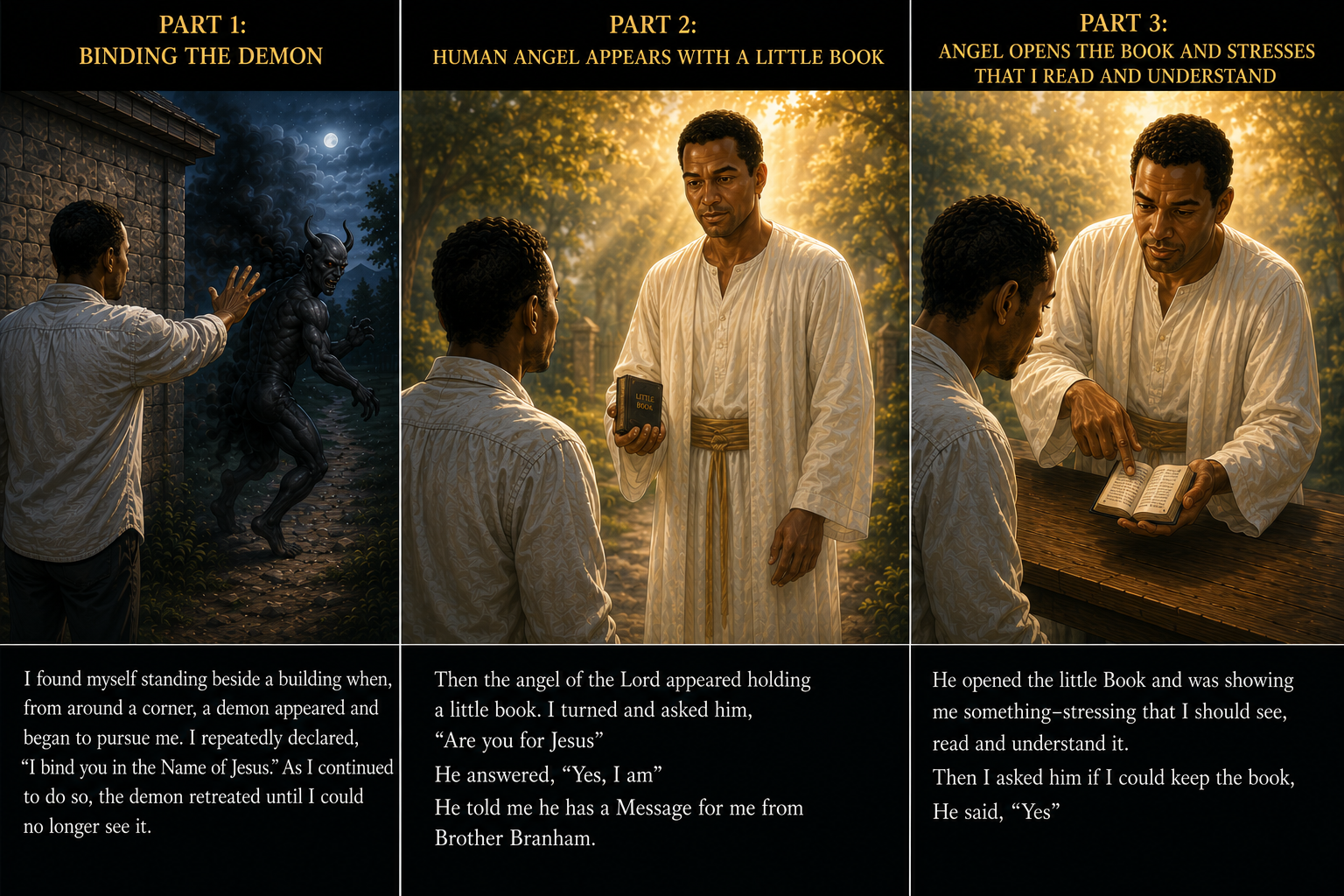
I had this dream in the year 2000.
I found myself standing beside a building when, from around a corner, a demon appeared and began to pursue me. I repeatedly declared, “I bind you in the Name of Jesus.” As I continued to do so, the demon retreated until I could no longer see it.
Then an angel of the Lord appeared. I turned and asked him, “Are you for Jesus?”
He answered, “Yes.”
He then told me that he had a message for me from Brother Branham. Opening a small book, he began to show me something, emphasizing that I should understand it. I then asked him if I could keep the book, and he replied, “Yes.”
Afterward, we entered what appeared to be a large hall, similar to a restaurant. I saw many people holding plates filled with food. Then the angel asked, “Is there nobody here to baptize these people?”
Reflections on the Dream
At the time, I did not fully understand the meaning of this dream. Many years would pass before I began to appreciate its possible significance. Looking back, I do not claim infallibility in interpreting dreams, for all spiritual experiences must ultimately be tested by the Word of God. Yet several impressions remained with me.
First, the retreat of the demon reminded me that receiving the truth would never be without spiritual opposition, but that the Lord Jesus Christ is greater than the powers of darkness and would prevail over them. Second, the little book suggested the importance of understanding truths that God desired me to examine carefully rather than blindly accept or reject. Third, the great hall filled with people carrying food seemed to point to a people who had received spiritual nourishment but still required obedience to the full counsel of God. The angel’s question, “Is there nobody here to baptize these people?” impressed upon me the need not only for teaching but also for faithful ministry and practical obedience.
Whether or not I fully grasped every detail, the dream awakened within me a deeper hunger for the Scriptures and a burden to serve God’s people. As the years passed, I came to understand that God often guides His children progressively, revealing His purposes step by step.
Prior to this dream, I had read of the little Book in Revelation 10, which the apostle John was commanded to eat, and I had reflected on the promise of Elijah in Malachi 4:5–6. Yet I had never heard of William Branham. Because of this, I found myself wondering whether there might be some connection between these Scriptures and the dream I had received. That question would remain with me and would eventually lead me to search the Scriptures more diligently and to examine whatever claims I encountered in the light of God’s Word.
Therefore, I regard this dream not as a foundation for doctrine, but as a providential experience that encouraged me to search the Scriptures diligently and to remain open to whatever truth God might graciously reveal through His Word. Like the Bereans of old, I desired not merely to accept or reject matters hastily, but to test all things and hold fast to that which is good.
Note:
It is important to understand that the Message of Malachi 4 is not to turn the heart of one brother against another. Rather, it is to turn the heart of the children back to the fathers. Its purpose is reconciliation with the apostolic faith, not division among believers.
When Men Judge, but God
Justifies
After the dream I had in 2000 concerning the little book, the angel, and Brother Branham, I became motivated to read his messages. I must confess that they contain teachings and insights not commonly emphasized in many mainstream churches. Yet the Bible instructs us not to despise prophecy, but to test all things and discern the spirits (1 Thessalonians 5:20–21; 1 John 4:1). That is what I sought to do.
As I studied his sermons, I found a strong call to contend for the faith once delivered to the saints and a desire to uncover mysteries that had long remained hidden and were, according to his understanding, being revealed in these last days.
I recognize that the Bible contains different literary genres, and that the Book of Revelation, along with other prophetic books, belongs to one of the most challenging. Many Bible scholars and ministers seldom teach these books, and some admit that they are difficult to understand. Yet all Scripture is profitable and worthy of careful study (2 Timothy 3:16).
God has given gifts unto men, and whenever I learn something that I believe to be beneficial, I am often stirred to share and discuss it with others.
Many years ago, I organized a conference and sent invitations to several church leaders. During the course of our discussions, the name of William Branham was mentioned, and this seemed to raise concern in certain circles. As a result, one church leader began to accuse me of being associated with a sect.
My intention, however, was never to create division, but to encourage sincere dialogue. I had been reading some of Rev. William Branham’s sermons and had come across teachings that I believed were worthy of discussion among fellow ministers. I hoped that these matters could be examined together in the light of Scripture, just as the Bereans searched the Scriptures daily to determine whether these things were so (Acts 17:11).
Instead, I experienced rejection and was judged without being given the opportunity for open discussion. It was a painful experience, especially since the criticism came from someone who was regarded as a spiritual authority in the community.
At the time, I chose not to respond in anger, but to commit the matter to prayer.
In later years, that minister experienced moral failure and was eventually prevented from preaching in his church for a season. This sobering development reminded me that all of us stand in need of God’s grace and that none of us is beyond temptation. It also taught me that we should be slow to judge matters we do not fully understand, lest we ourselves suffer humiliation in the process.
As the years have passed, life has taught me that only God truly knows the heart of man. I have learned that ultimate judgment belongs to Him alone, while we are called to walk in humility, charity, and reconciliation. Men may misunderstand and condemn, but God, who sees the secrets of the heart, is both just and merciful. His purpose is not merely to expose, but to redeem and restore those who trust in Him.
As Scripture says, “Who shall lay anything to the charge of God’s elect? It is God that justifieth” (Romans 8:33).
The Little Book: Receiving, Revealing, and Living the Word
What follows is my interpretation of these dreams. I do not expect others to accept my interpretation simply because I experienced them. Nevertheless, I believe the dreams contain scriptural symbolism.
The little book immediately reminded me of the little book mentioned in Revelation chapter 10. The Apostle John was instructed to eat the book, and I came to believe that John, in this prophetic picture, represented the end-time Bride receiving truths that God would reveal in the last days.
What follows is how I came to understand this experience through four stages: Confirming, Receiving, Revealing, and Fulfilling.
Confirming
It was a difficult period in my life. I was seeking God concerning where I should worship because I felt that the church I was then attending lacked the spiritual power to help me through the struggles I was facing.
In answer to my prayers, God sent a pastor to our home approximately two weeks later. He preached to me and invited me to attend his church.
After attending that church for about a month, I had the dream concerning the angel and the little book.
I came to believe that the dream served as a confirmation, reassuring me as a newcomer in the fellowship not to fear or regard its teachings as strange, but rather to search the Scriptures for myself.
The church believed the message associated with the ministry of Rev. William Branham, and I understood the dream as an encouragement to examine those teachings carefully in the light of Scripture.
Receiving
I felt compelled to read every available book by Brother Branham in our small church library.
Even in the dream, the angel pointed with his finger to the page, emphasizing that I should look, read, and understand.
As I studied these messages, I came to see what I believed were several important truths that had been revealed but were often ignored or avoided by many believers. I was particularly surprised to discover that even the subject of water baptism and the relationship between Matthew 28:19 and Acts 2:38 remained a matter of disagreement among many churches.
I also discovered that the messages continually pointed believers back to the apostolic faith. From my perspective, there appeared to be no compromise in Brother Branham’s preaching.
The Bible contains different literary genres, and all Scripture is profitable for doctrine, correction, and instruction in righteousness. Yet I came to realize that books dealing with prophecy and mystery, such as Daniel and Revelation, were often neglected or seldom preached in many mainstream churches.
The angel’s emphasis in the dream—to look, read, and understand—strongly motivated me to receive and examine the Message for myself in the light of Scripture.
John’s being instructed to eat the little book in Revelation chapter 10 is one of the most powerful symbols in biblical prophecy. To eat the book signifies more than simply reading God’s Word. It speaks of receiving God’s message so deeply that it becomes part of one’s inner life.
To eat the Book is to:
- Read it.
- Digest it.
- Live it out.
In this sense, I came to believe that I was “eating the Book.”
Eating the Book, as I came to understand it, refers to receiving, internalizing, and living out the Word of God until it becomes part of one’s thinking, character, and spiritual life. It is the difference between merely possessing knowledge and allowing truth to transform the heart.
Revealing
I must say that I came to learn many things, gained an understanding of mysteries, and saw many truths revealed to me after receiving the Message.
It was, in my experience, both sweet in the mouth and bitter in the stomach.
It was sweet because of the joy of discovery, the excitement of understanding Scripture more deeply, and the sense of drawing closer to the apostolic faith. Yet it was bitter because truth often comes with a cost. New convictions can bring misunderstanding, opposition, spiritual battles, and personal sacrifice.
This brought the words of Revelation 10 vividly to my mind:
“Take it, and eat it up; and it shall make thy belly bitter, but it shall be in thy mouth sweet as honey.”
Revelation 10:9
John later testified:
“It was in my mouth sweet as honey: and as soon as I had eaten it, my belly was bitter.”
Revelation 10:10
Sweet in the Mouth
God’s Word is often described as sweet, delightful, and desirable. Receiving divine revelation can bring joy. Discovering truth can produce excitement and spiritual satisfaction. Understanding mysteries of Scripture can fill the believer with wonder and gratitude.
The Psalmist declared:
“How sweet are thy words unto my taste! yea, sweeter than honey to my mouth!”
Psalm 119:103
To eat the Book, therefore, symbolizes more than simply reading it. It means receiving God’s message so deeply that it becomes part of one’s inner life.
Bitter in the Stomach
Yet once the message is received, digested, and lived out, the experience can become difficult.
The bitterness may involve opposition and persecution for believing or preaching the message, the burden of carrying a difficult truth, sorrow over unbelief or spiritual decline, and the personal cost of obedience and sacrifice.
The prophets frequently experienced such burdens. God’s message was glorious, yet carrying it could bring loneliness, rejection, and suffering.
This symbolism is not unique to Revelation. The prophet Ezekiel was also commanded to eat a scroll:
“Then did I eat it; and it was in my mouth as honey for sweetness.”
Ezekiel 3:3
Afterward, Ezekiel was sent to deliver a difficult message to Israel.
Thus, I see a pattern:
Revelation → Reception → Responsibility → Suffering
The message is sweet when received, but it can become bitter when its consequences are experienced.
The little Book was sweet in the mouth because the discovery of truth brought joy, understanding, and spiritual excitement. Yet it became bitter in the stomach because truth often carries a cost. To receive and hold firmly to a conviction may invite misunderstanding, opposition, and trials.
Revelation is sweet to receive, but it can be bitter to bear.
Fulfilling
After the receiving and the revealing came what I understand as the fulfilling.
In 2008, I had another dream that I believe was connected with the little Book.
In the dream, I heard a knock at the front door of my house. A voice impressed upon me not to open the door, but instead to go behind the house and see who was knocking.
As I looked, I saw a strange creature with the head of an animal and the body of a man.
The creature noticed me and began to move toward me. I also found myself moving toward it.
Suddenly, I took a little book from my back pocket and pointed it toward the creature. Immediately, a whirlwind descended from above, lifted the creature into the air, and carried it away. As it disappeared, it made a strange and ghostly sound as it was taken to a place unknown to me.
Looking back, I came to understand this dream as another reminder that the adversary resists spiritual growth and opposes believers in many ways. As the Word of God grows within a person, trials and opposition may sometimes increase rather than decrease.
Yet the Scriptures remind us that the testing of faith produces endurance and that God is faithful to preserve those who seek Him in sincerity and truth.
I also came to believe that when the Word of God is fully received, revealed, and established within a person, the power of the enemy is broken. Our Lord Jesus overcame the adversary through the Word, declaring:
“Get thee behind me, Satan: for it is written…”
Luke 4:8
The lesson I drew from the dream was simple: before truth reaches the heart, the devil will fight to prevent it. Yet once the Word of God is received, believed, and established within a person, the enemy cannot stand before it. The Word defeats him every time.
Had I Been Eating the Book?
The whirlwind came and picked up the beast after I took the little Book from my pocket and showed it to the creature.
One brother, after hearing my dream, told me, “It means you have been eating the Book.”
But does the dream actually signify that I had been eating the Book?
I cannot say with certainty.
God is His own Interpreter.
Nevertheless, I could not ignore the connection. The little Book had already appeared in my earlier dream, and in this second dream it was now in my possession. When I showed it to the beast, the whirlwind came from above and carried the creature away.
Could this signify that the Word of God had become something I was not merely reading, but receiving, internalizing, and living out?
I leave the interpretation with God.
What I can say is that, over the years, the Word became increasingly precious to me. It was, in the language of Revelation 10, sweet in the mouth but bitter in the stomach. The truth brought joy and understanding, but it also brought opposition, trials, and a cost.
Personal Reflection
Immediately after eating the Book, John was told:
“Thou must prophesy again before many peoples, and nations, and tongues, and kings.”
Revelation 10:11
This sequence is significant to me:
- Receive the message.
- Digest the message.
- Become part of the message.
- Proclaim the message.
One cannot faithfully speak God’s Word without first allowing it to work within oneself.
Since my dreams involved a little Book, it was natural for me to connect them with Revelation 10. From my interpretation, the symbolism can be understood in this way:
- The little Book being given — receiving truth or revelation.
- The angel emphasizing that I should look, read, and understand — the importance of study and discernment.
- Being allowed to keep the Book — stewardship of what has been entrusted to me.
- The little Book later appearing in my possession — truth becoming something personally received and carried.
- The conflict with the beast — spiritual opposition that can accompany deeply held convictions.
- The whirlwind carrying away the beast — the victory of God’s power over the opposing force.
A book that is eaten becomes part of the person who receives it. Perhaps that is why neither Ezekiel nor John was told merely to read the book. They were told to eat it.
My interpretation belongs to my personal testimony and spiritual reflection. Christians may understand Revelation 10 differently, and I respect that. Nevertheless, I believe the broader biblical principle remains clear: God’s Word is to be received, internalized, lived out, and faithfully proclaimed.
The little Book was sweet because revelation brings joy; it was bitter because truth often carries responsibility, opposition, and sacrifice.
It is sweet to receive the Word, but it may be bitter to bear the burden of the Word.